

Being a billionaire is no longer enough to get anywhere near the Forbes 400.
That is a record, up from $3.8 billion last year and $1.7 billion a decade ago. Put another way, the price of admission rose about 16% in a single year.
Artificial intelligence is a big reason. AI companies have reached enormous valuations, established technology businesses are benefiting from spending on data centers and computing infrastructure, and investors continue to place very large values on companies positioned anywhere near the AI buildout.
Still, you should be careful about reducing the entire increase to AI. The Forbes 400 is also benefiting from a strong stock market, rising private-company valuations, and some extraordinary gains at the very top.
The bigger point is harder to miss. Wealth creation at the top end of the U.S. economy is moving very quickly, and technology is doing much of the pushing.
The Forbes 400 Is Now Worth $8 Trillion

The 400 people on the 2026 list are worth an estimated $8 trillion combined, according to Forbes’ 2026 figures. A year earlier, they were worth $6.6 trillion.
That is a $1.4 trillion increase, or a little more than 21%, in one year.
For perspective, the cutoff itself has climbed like this:
- 2016: $1.7 billion
- 2025: $3.8 billion
- 2026: $4.4 billion
A fortune that would have comfortably secured a place on the list a decade ago would now leave someone billions of dollars short.
A record 590 American billionaires missed the list in 2026, which gives the cutoff a little more perspective.
That figure is more revealing than some of the eye-catching fortunes near the top. The United States now has hundreds of people worth at least $1 billion who are still nowhere close to being among its 400 richest citizens.
Billionaire used to sound like the finish line. At this end of the wealth distribution, it is apparently closer to qualifying for the preliminary round.
AI Is Creating Fortunes at Startup Speed

The clearest evidence of AI’s influence can be found among the newcomers.
Despite the $4.4 billion entry requirement, 34 people joined the Forbes 400 for the first time in 2026. More than a dozen of those newcomers made their fortunes from artificial intelligence.
OpenAI cofounder Greg Brockman was the richest new entrant, with Forbes estimating his fortune at $25.5 billion.
Six Anthropic cofounders also joined the list, with Forbes valuing each of their fortunes at roughly $15.5 billion. Cognition AI cofounder Steven Hao, 30, entered with an estimated $5.8 billion.
Age makes the change even more obvious. According to Forbes’ look at the youngest Forbes 400 members, only four people on the list were under 40 last year. There are now ten, and all seven of the under-40 newcomers built their fortunes through AI-related businesses.
That is unusually fast wealth creation.
While AI is creating new fortunes, inheritance remains a major route onto the list for women. Of the 62 women on the 2026 Forbes 400, 49 inherited their wealth, highlighting a different path to the same ranking.
Many great American fortunes were built over decades. A successful manufacturer might expand factories for 30 years. A retailer could spend a generation opening stores. Even a software company once needed considerable time to reach a valuation capable of producing a $10 billion founder.
AI has compressed that timeline dramatically. Investors are assigning enormous values to companies that barely existed several years ago.
A $15 Billion Fortune Is Not Necessarily $15 Billion in Cash
Public-company holdings are relatively straightforward because there is a market price available every trading day. Forbes calculated its 2026 ranking using public share prices from September 4.
Private AI companies are more complicated.
A founder’s fortune can be calculated from an ownership stake multiplied by a recent company valuation. If investors value a startup at hundreds of billions of dollars, even a modest ownership percentage creates an enormous theoretical fortune.
The word theoretical is what you should pay attention to.
Private shares cannot necessarily be sold quickly, and a fundraising valuation does not guarantee that every share could actually be sold at the same price.
Funding rounds can also contain different share classes, liquidation preferences, and other terms that make headline valuations less clean than they appear.
None of that means the fortunes are imaginary. It means they are heavily tied to what investors currently believe the companies are worth.
A $15 billion estimate attached to a private AI stake is very different from having $15 billion in Treasury bills. That distinction becomes important if AI valuations ever cool.
The AI Boom Goes Far Beyond AI Startups

Founders of young AI companies are only part of the story. Alphabet cofounder Larry Page was worth an estimated $278 billion on the 2026 Forbes 400 after Alphabet shares climbed nearly 60% amid growth in Google Cloud and Gemini.
Michael Dell moved into fourth place as Dell Technologies benefited from surging demand for AI servers.
Nvidia, cloud infrastructure, networking equipment, data centers, and power demand have turned AI into something much larger than a software story.
That’s very important when looking at who is getting rich from the boom.
The most durable fortunes may not necessarily belong to whichever chatbot attracts the most attention.
Companies selling the chips, servers, cloud capacity, electricity, and infrastructure needed to run AI can make money regardless of which individual model eventually wins.
Gold rushes tend to be very good for shovel sellers. Technology has simply made the shovels considerably more expensive.
The Wealth Boom Is Also Extremely Concentrated
AI explains part of the record, but concentration explains another.
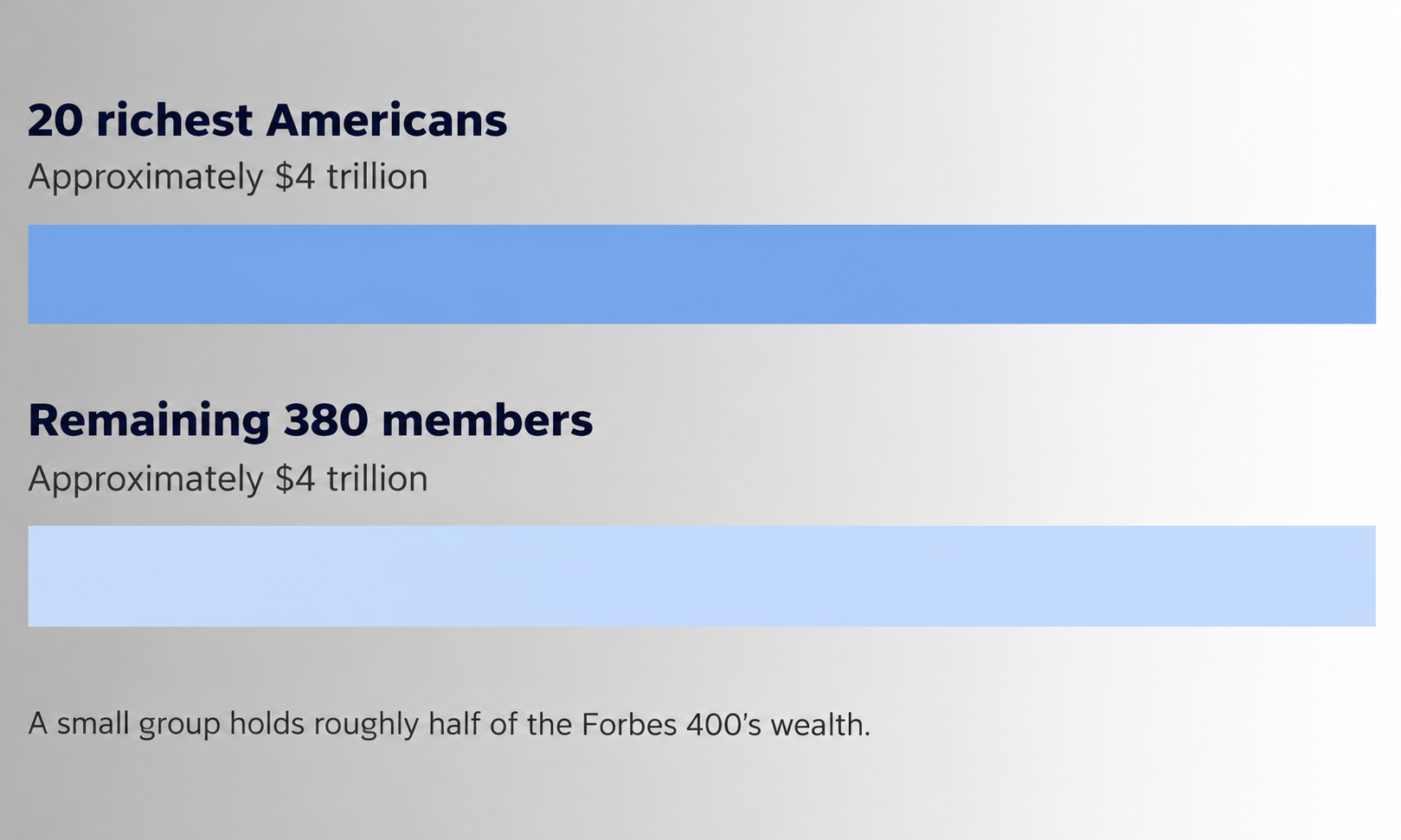
The 20 richest Americans alone are now worth about $4 trillion, or roughly half the combined wealth of the entire Forbes 400. They gained nearly $1 trillion over the past year.
This concentration extends well beyond the Forbes 400. Federal Reserve data shows that the richest 1% of Americans own more than half of the country’s corporate-equity and mutual-fund wealth, illustrating just how unevenly investment assets are distributed.
These fortunes exist on a very different scale from what ordinary Americans consider financially comfortable.
Elon Musk illustrates just how distorted the averages can become. Forbes estimated Musk’s fortune at $908 billion, up $480 billion from the previous Forbes 400 after SpaceX went public and his other holdings increased in value.
Remember that the entire Forbes 400 gained $1.4 trillion. Musk alone therefore accounted for roughly one-third of the increase.
That is why you should not look at the jump from $6.6 trillion to $8 trillion and conclude that every billionaire had an equally spectacular year. Three-quarters of returning members did become richer, but the gains at the very top were enormous enough to move the entire group.
Average wealth is rarely very informative when one person is approaching $1 trillion.
For a broader perspective on wealth concentration, Robert Reich discusses America’s wealth gap and argues for higher taxes on the rich in the video below.
Video: Robert Reich, “The Hidden Danger of America’s Wealth Gap,” via YouTube.
$4.4 Billion Says More Than the Ranking Does
Rich lists are entertaining because humans apparently never tire of finding out which extremely rich person is slightly richer than another extremely rich person.
The cutoff is more interesting. Going from $1.7 billion a decade ago to $4.4 billion today means the entry requirement has increased by roughly 159%.
AI has accelerated that rise by creating new fortunes and increasing the value of businesses that supply the industry’s infrastructure. Strong equity markets and other technology gains have added fuel.
Whether those valuations hold is the question worth watching.
In a LinkedIn post, Walker Deibel argues that the next major AI opportunity lies in deployment: helping businesses turn AI capabilities into measurable results. That perspective adds another question to the wealth boom: can companies deliver the performance investors are pricing in?
Video: Walker Deibel via LinkedIn. Originally shared in his Wealth Stack Weekly post.
If AI companies eventually produce profits that justify today’s expectations, some of the fortunes appearing almost overnight could prove remarkably durable. If valuations come down, private-company wealth can disappear on paper nearly as quickly as it appeared.
For now, the market is voting enthusiastically. Four billion dollars used to make someone one of the richest people in America.
In 2026, it does not even guarantee a seat at the table.