
You can now put money on whether the Federal Reserve will cut interest rates, which political party will win an election, or whether a particular football team will reach the playoffs.
On Kalshi and Polymarket, these transactions are presented as trades in financial contracts.
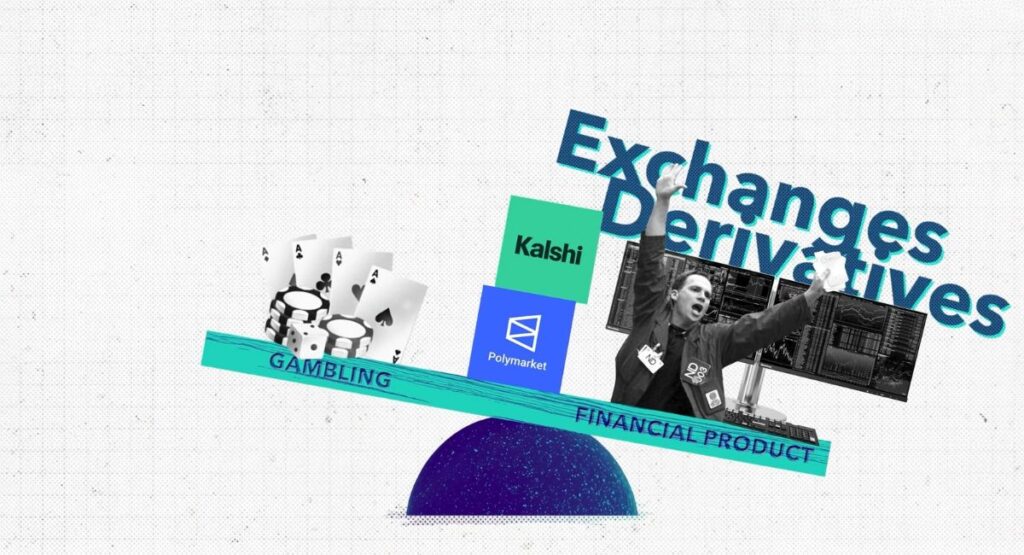
To many customers, they look remarkably similar to bets. That distinction has become one of the most consequential questions in the rapidly expanding prediction market industry.
The companies argue that they operate marketplaces where participants trade contracts reflecting the probability of future events.
Gambling regulators counter that at least some of those contracts, particularly those involving sports, amount to wagering under another name.
Both arguments deserve attention.
But what is most interesting, however, is something simpler:
What exactly does someone purchase when they spend $100 on a prediction market, and where does the money go?
The answer tells us considerably more than the label attached to the transaction.
What Are You Actually Buying?
Prediction markets sell contracts whose value depends on the outcome of a defined future event.
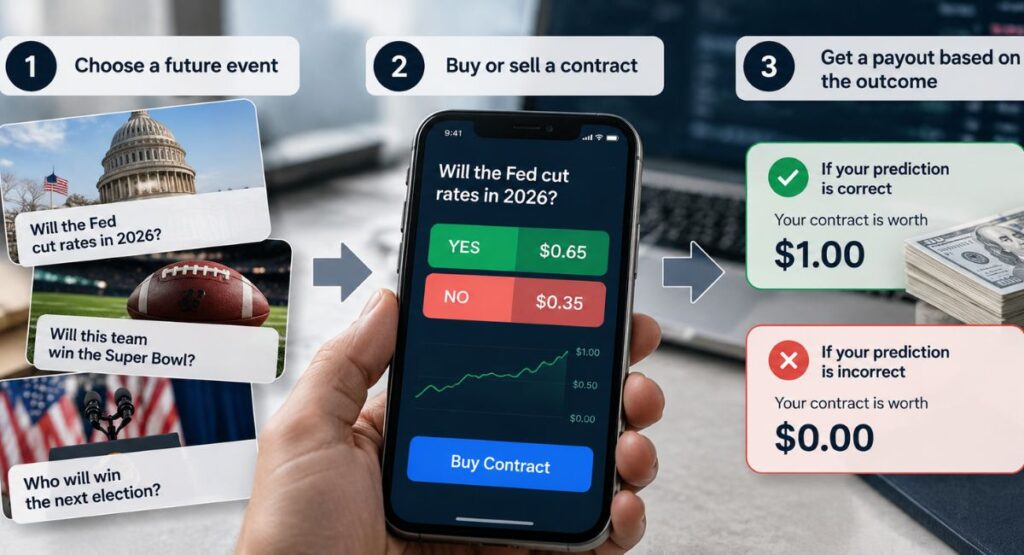
Imagine a market asking whether the Federal Reserve will lower interest rates at its next meeting. A contract predicting “Yes” trades at 65 cents. If you buy 100 contracts, the basic economics look like this:
There is no ownership in the Federal Reserve, no underlying business generating earnings, and no dividend. You own a contractual right to a payment determined by an event.
According to Kalshi’s explanation of event contracts, standard Yes/No contracts settle at $1 for the winning outcome and zero for the losing outcome.
Importantly, traders generally don’t need to hold contracts until settlement. They can sell their positions earlier if another participant is willing to buy.
That creates a secondary trading market where prices change as expectations change.
It also makes prediction markets more complicated than placing a conventional wager and waiting for the final score.
Kalshi and Polymarket Sell Access to a Marketplace
The business model becomes clearer when we examine who takes the other side of a trade.
At a traditional sportsbook, the operator establishes betting lines and generally accepts the financial exposure associated with customers’ wagers.
Kalshi operates differently. It matches participants who want opposite positions on an event. Buyers and sellers determine prices through trading activity, while the exchange collects transaction fees. Kalshi explains this arrangement in its revenue model.
The company isn’t supposed to profit because one football team defeats another. It earns money by facilitating trading.

Polymarket uses a broadly similar marketplace concept, although its operating structure deserves clarification.
The international Polymarket platform uses blockchain infrastructure and cryptocurrency-backed outcome shares. Its separate American operation, Polymarket US, is a federally regulated exchange.
Polymarket’s platform transparency information distinguishes the two businesses, which operate under different rules. Both companies offer access to prices formed by participants with competing expectations.
BBC News explores how prediction markets like Polymarket have grown and why their business model is attracting regulatory scrutiny.
That is a genuine structural difference from a conventional bookmaker. But here’s where one can become skeptical of the industry’s preferred explanation.
An exchange can be financially different from a sportsbook while offering customers an experience that feels almost identical.
If someone spends $50 predicting an NFL winner, the immediate financial objective remains to make money by correctly anticipating the result. Calling the position a derivative doesn’t eliminate that similarity.
Are Prediction Market Prices Real Probabilities?
One of the industry’s strongest selling points is information. A contract trading at 72 cents is commonly interpreted as indicating a 72% probability that an event will happen. But that number isn’t a scientific measurement. It’s a market price.
Polymarket’s pricing explanation describes how displayed probabilities are derived from its order book, generally using the midpoint between buying and selling prices.
Those prices reflect what participants are willing to pay. Sometimes that produces an excellent forecast.

Other times, markets can be distorted by limited liquidity, enthusiasm, incomplete information, or participants who misunderstand the event. A contract priced at 90 cents can still lose its entire value.
And even a prediction that has a 90% chance of being correct isn’t necessarily a profitable purchase at 90 cents after trading costs.
That’s a distinction worth remembering.
Being right frequently is not the same thing as making money.
The Gambling Question Is Now a Legal Fight
Kalshi is registered with the Commodity Futures Trading Commission (CFTC) as a designated contract market. Polymarket US also operates under federal commodities oversight.
That federal status forms the foundation of their argument that event contracts are financial derivatives rather than products governed entirely by state gambling regulations.
Several states disagree, particularly when contracts involve sporting events. The disagreement has produced conflicting federal court decisions.
Bloomberg Law examines the legal dispute over whether Kalshi and Polymarket offer financial derivatives or gambling products.
In April 2026, the Third Circuit sided with Kalshi at the preliminary-injunction stage in its dispute with New Jersey, supporting the company’s argument that federal commodities law preempts the state’s gambling restrictions.
In August, the Ninth Circuit reached a different conclusion in a case involving Nevada, finding that Kalshi was unlikely to establish that federal law prevented Nevada from regulating its sports contracts. Neither decision represents a final nationwide resolution.
Meanwhile, the CFTC announced a new proposed regulatory framework in June 2026 to address event contracts involving activities including gaming.
Don’t assume this debate will be resolved simply by calling these products financial instruments.
The courts are examining the actual contracts and the laws governing them. That’s appropriate. Legal classification should depend on more than marketing language.
For additional context, we recently examined Kalshi’s advantage over traditional sportsbooks, including its ability to reach certain customers that state-licensed sportsbooks cannot.
That commercial advantage makes the regulatory outcome particularly important.
Prediction Markets Can Have Financial Uses Beyond Betting
It would be a mistake to conclude that every prediction market transaction serves the same purpose.
Consider a business whose earnings could suffer during an unusually warm winter. In principle, a contract tied to winter temperatures could help offset some of that exposure.
An investor might similarly use an economic event contract to hedge against an outcome that would hurt another investment. Those activities can provide practical financial protection.

Now consider someone buying a contract predicting the winner of a celebrity competition. The contract mechanics may be similar. The economic purpose probably isn’t.
One participant is managing exposure to an existing risk. Another is speculating on an uncertain outcome.
Both face potential losses, but their reasons for accepting those losses differ. That’s why the blanket statements are unhelpful.
Not everything traded on a financial exchange is a productive investment. And not every contract involving an uncertain event is economically equivalent to a casino wager. Purpose truly matters.
The Bigger Problem May Be Confusing Speculation With Wealth Building
Prediction markets have another feature that deserves scrutiny: they transform almost any disagreement about the future into a financial transaction.
That can be entertaining and occasionally informative. It can also encourage excessive trading.
The CFTC’s February 2026 enforcement advisory highlighted cases involving improper trading activity and misuse of nonpublic information on prediction markets.
These markets aren’t immune to the misconduct that financial regulation exists to discourage.
Another concern is how easily prediction markets can become intertwined with people’s broader financial habits.
In an earlier CountedWealth article, we examined young investors redirecting money toward sports betting.
The lesson applies here, too. Money allocated to speculation is money unavailable for other purposes.
A diversified portfolio can represent long-term ownership in productive companies. A prediction contract generally pays according to a specific event’s outcome.
A diversified investment portfolio can accumulate ownership in productive businesses over decades.
A prediction contract usually has a defined endpoint. Its eventual payout depends on the outcome specified in its rules, not years of corporate earnings growth.
That doesn’t automatically make the contract worthless or inappropriate. It makes it a different financial tool.
So, Are Prediction Markets Gambling?
Our answer depends on which question is asked.
Legally, the classification remains contested for certain contracts, particularly sports-related products.
Structurally, Kalshi and Polymarket operate marketplaces where participants trade claims on future outcomes rather than simply placing conventional bets against a bookmaker.
Economically, many transactions still resemble gambling: a participant risks money on an uncertain event, hoping to receive a larger payout.
We wouldn’t dismiss prediction markets as nothing more than online casinos. They can aggregate information, reveal changing expectations, and potentially help people manage real financial risks.
But we also wouldn’t describe buying a contract on the next football game as investing simply because the transaction happens on a regulated exchange.
The most interesting product Kalshi and Polymarket sell may not be the contracts themselves.
It’s the ability to attach a continuously changing dollar price to uncertainty.
That information can be valuable.
Whether paying for exposure to it is a sensible financial decision is an entirely separate question.
This article is for general informational purposes and does not constitute personalized financial, investment, tax, or legal advice.