

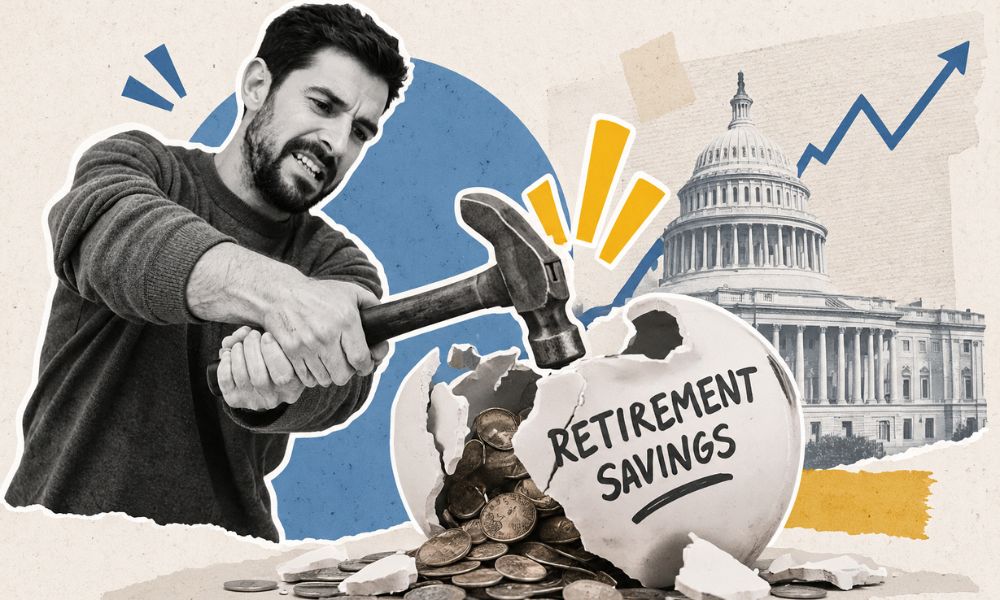
Nearly one in five Americans with a Fidelity-managed 401(k) has borrowed money from their retirement account and still owes it back.
According to the latest retirement savings data, 19.5% of Fidelity’s 401(k) participants had an outstanding loan at the end of June 2026, up from 19.2% in the previous quarter.
That’s a substantial number of workers making payments into accounts they originally built to fund their retirement.
The interesting part is that retirement savings are doing remarkably well on paper. Account balances are setting records, contributions are holding up, and millions of workers are accumulating wealth through their employers.
That contrast has become even more striking now that Fidelity reports a record 769,000 401(k) millionaire accounts, highlighting how rising retirement wealth and short-term financial pressure can exist at the same time.
Yet a sizable group is borrowing against those same savings. However, don’t think every 401(k) loan represents financial trouble. Some are perfectly rational borrowing decisions.
Still, the figures raise a question worth examining: How much financial security does a growing retirement account actually provide when its owner needs to borrow from it to manage today’s expenses?
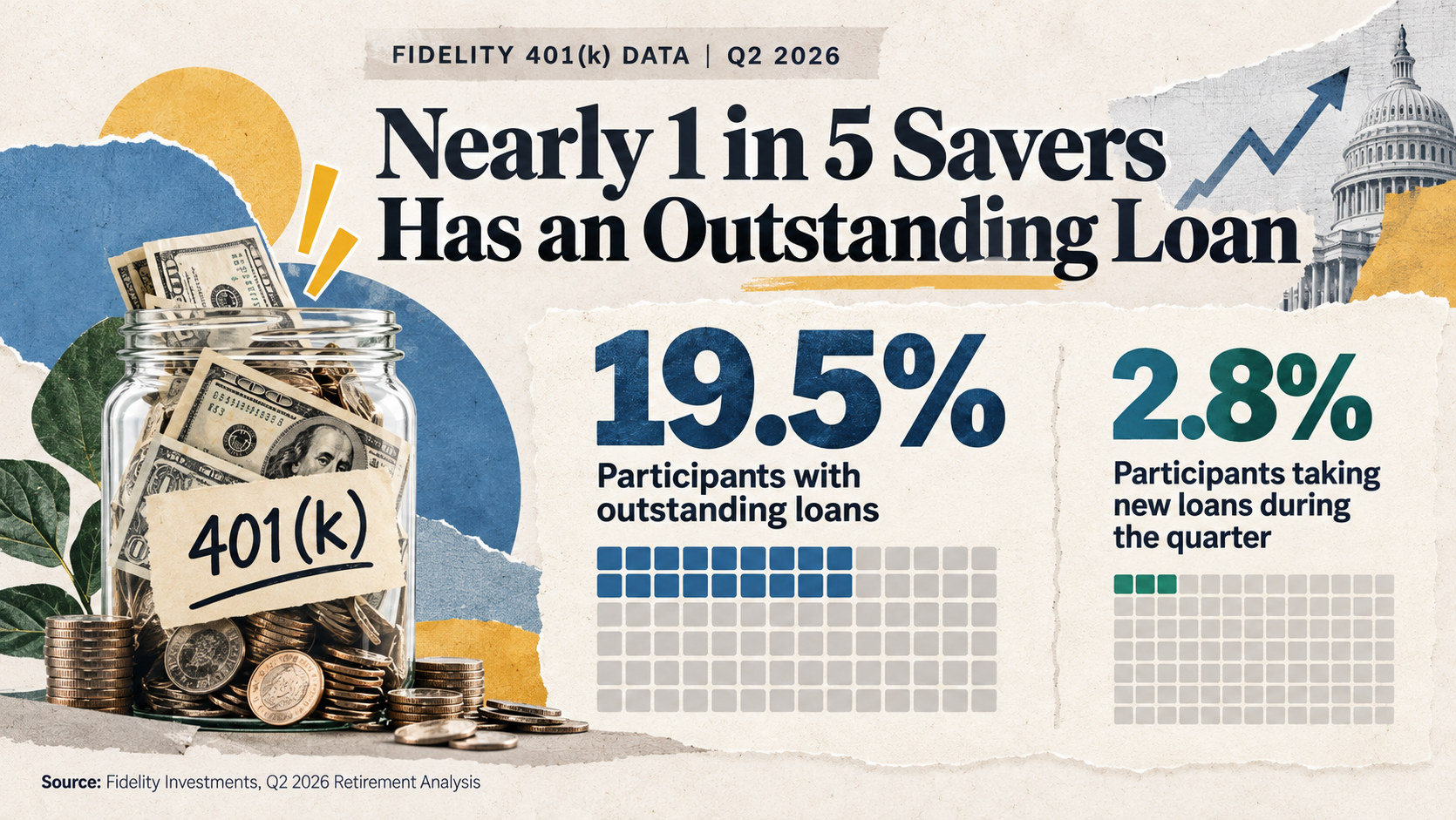
Nearly 20% of Fidelity Participants Have Outstanding Loans
The latest Fidelity retirement analysis covers approximately 25.8 million 401(k) participants across 27,300 corporate retirement plans.
The second-quarter figures reveal two different stories about Americans’ retirement finances.
| Retirement measure | Q2 2026 |
|---|---|
| Average 401(k) balance | $155,800 |
| Average total savings rate, including employers | 14.4% |
| Participants with outstanding loans | 19.5% |
| Participants taking new loans during the quarter | 2.8% |
| Participants receiving their full employer match | 81.2% |
One distinction matters here. Nearly 20% had existing loans, but only 2.8% took out new ones during the quarter. We aren’t seeing one-fifth of workers suddenly borrowing from their retirement accounts every three months.
The outstanding-loan rate also tells us nothing about what borrowers purchased or whether they’re struggling to make repayments. And the figure isn’t a national rate.
Vanguard’s separate How America Saves 2026 report found that 13% of participants in plans offering loans had outstanding balances at the end of 2025.
Different providers serve different employers and workers. Combining those percentages into some imaginary national average would be bad statistics.
Still, both findings establish that borrowing against retirement savings is a routine financial decision for millions of workers.
Why Borrowing From Your 401(k) Looks Attractive
A 401(k) loan has one appealing feature that traditional borrowing doesn’t. You’re effectively borrowing from yourself.
Instead of paying interest to a bank, you repay the loan with interest credited to your retirement account. There’s generally no conventional credit check, and a properly administered loan doesn’t create an immediate income-tax bill.
Under IRS retirement-plan rules, workers can generally borrow up to 50% of their vested account balance, subject to a $50,000 maximum and other limitations. Most loans must be repaid within five years, although loans used to purchase a primary residence can qualify for longer repayment periods.
Employers aren’t required to offer loans, and individual plans can impose additional restrictions. That appeal is understandable.
Someone facing a large medical bill or expensive home repair might prefer borrowing from a retirement account rather than carrying credit card debt at a punishing interest rate.
The money is already there. Repayments usually come directly from payroll. Interest returns to the borrower’s account. It sounds almost too convenient. That convenience is precisely why the financial trade-offs deserve attention.
For a closer look at how these loans work, Fidelity Investments explains the advantages, repayment rules, and potential risks of borrowing from a 401(k) in its Money Unscripted video.
Paying Interest to Yourself Doesn’t Make the Loan Free
The biggest misconception about 401(k) loans is that paying interest to yourself eliminates the borrowing cost. It doesn’t.
When money leaves your invested retirement portfolio, that borrowed portion generally stops participating in market gains or losses until repayments return it to the account.
Consider someone borrowing $10,000 during a strong stock market.
That $10,000 is no longer invested in the same way. The borrower gradually restores the balance through repayments, but the money doesn’t necessarily participate in the full market recovery or rally.
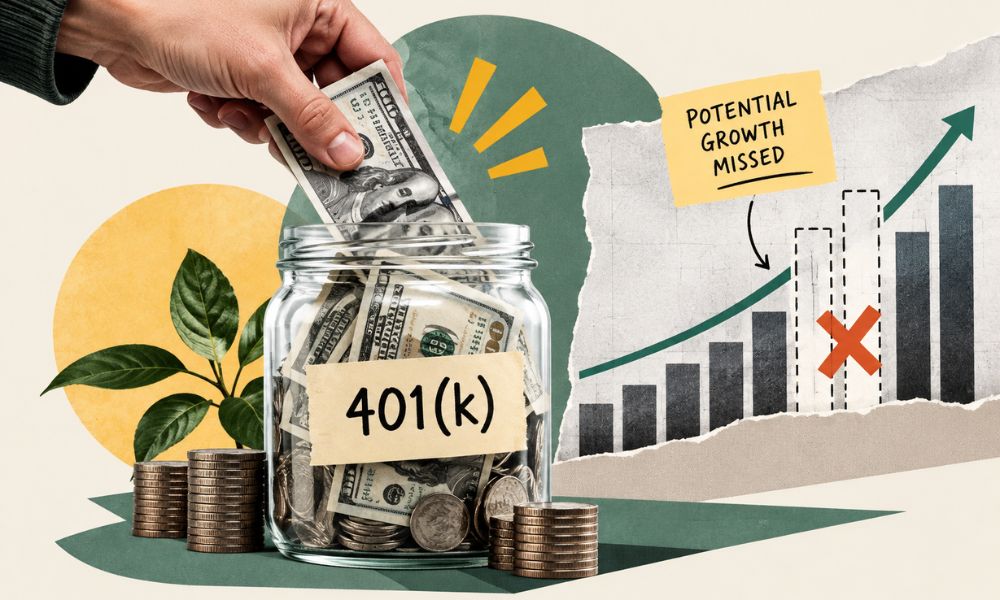
Of course, markets can also decline. Borrowed money temporarily outside the market could avoid losses.
The point isn’t that every 401(k) loan produces an investment loss. It’s that borrowing changes the investment outcome.
There’s another issue that is more concerning.
Loan repayments take money out of future paychecks. If that forces someone to reduce regular retirement contributions, they may lose additional investment growth and potentially part of their employer match. That’s a much worse arrangement than simply moving retirement money around temporarily.
It also illustrates something we explored in our article about how Americans own stocks. Participating in the market matters, but the amount of money continuously invested determines how much someone benefits from long-term growth.
The Biggest Risk Comes When Someone Changes Jobs
A 401(k) loan becomes considerably less attractive when employment changes.
Borrowers typically repay through their employer’s payroll system. Leaving that employer can disrupt the arrangement.
Some retirement plans allow former employees to continue repayments. Others require outstanding balances to be settled after employment ends.
Tax professional Moshe Mindick highlights another consideration when leaving an employer: transferring an old 401(k) into an IRA can eliminate the option of borrowing against those retirement savings. The rules for existing loans and new borrowing depend on the individual retirement plan.
If the loan isn’t handled according to the plan’s requirements, the unpaid amount can become taxable. Borrowers younger than 59½ could also face a 10% early-distribution penalty unless an exception applies.
Certain plan-loan offsets qualify for an extended rollover deadline, potentially giving borrowers until their federal tax-return filing deadline, including extensions, to replace the money in an eligible retirement account.
That relief is useful, but it still requires finding the money. This employment risk deserves considerably more attention than it receives.
Someone borrowing from a 401(k) because their finances are already stretched is exactly the person who could struggle to repay a large balance after losing a paycheck.
A loan intended to solve a temporary cash problem can become a retirement setback at the worst possible time.
Retirement Savings Are Increasing, but Cash Reserves Matter
Fidelity reported an average 401(k) balance of $155,800 in the second quarter of 2026, up 13% from a year earlier.
That’s encouraging. The average, however, includes accounts with very large balances and shouldn’t be mistaken for what a typical worker has saved.
More importantly, retirement balances don’t tell us how much accessible cash a household has.
A person can have $100,000 invested for retirement and struggle to cover an unexpected $3,000 expense.
Someone else might have $30,000 invested and enough emergency savings to handle several months without income.
The first person has the larger retirement account. The second could be in a stronger position to handle a financial emergency.
Our previous examination of Americans’ difficulty calculating their net worth raised a related issue. An account balance is one financial figure, not the entire household balance sheet.
Retirement savings, accessible cash, outstanding debt, and monthly expenses all contribute to financial stability.
A large 401(k) is valuable. It doesn’t automatically solve a cash-flow problem.
Not Every 401(k) Loan Is a Bad Decision
Borrowing from a 401(k) isn’t automatically irresponsible for someone paying 25% interest on credit card debt. The wisdom of any financial decision depends on the available alternatives.
Replacing expensive debt with a lower-cost retirement-plan loan can make sense, provided the borrower understands the repayment requirements, avoids accumulating new debt, and keeps contributing toward retirement.

Borrowing to cover an essential expense can also be reasonable when other funding options are worse.
Retirement loans deserve greater scrutiny when used to finance discretionary purchases or expenses that haven’t been carefully assessed against the borrower’s actual budget.
The distinction matters. A financial tool can be useful without being suitable for every purpose.
Before taking a 401(k) loan, You’d want clear answers to four questions:
- Can I make every repayment without reducing regular retirement contributions?
- What happens to the outstanding balance if I leave my job?
- How much potential investment growth am I giving up?
- Is another borrowing option cheaper or less risky after considering all costs?
Also, check administrative fees. Paying interest to yourself doesn’t mean the plan administrator works for free.
What the One-in-Five Figure Really Tells Us
The 19.5% loan rate doesn’t prove that American workers are becoming financially irresponsible. It doesn’t even prove every borrower is experiencing financial distress.
What it demonstrates is that retirement accounts serve two financial purposes for a meaningful share of workers.
They’re long-term investment portfolios and, when necessary, sources of short-term borrowing.
There’s a genuine tension there.
The 401(k) system has become increasingly effective at getting people enrolled, contributing, and investing. Fidelity’s record savings figures demonstrate real progress.
But a retirement account cannot fully compensate for inadequate cash reserves or a household budget with no room for unexpected expenses.
Building retirement wealth and maintaining financial flexibility are separate goals. Both deserve attention.
The encouraging news is that most 401(k) participants aren’t carrying plan loans, and many are continuing to increase contributions.
For the nearly one in five Fidelity participants who do have outstanding loans, the important question isn’t simply whether they’ll repay the money.
It’s whether they can repay it without compromising the retirement savings they’re trying to build.
This article is for informational purposes and does not constitute personalized financial, tax, or investment advice.