


Three out of four Americans couldn’t estimate their net worth without checking their financial accounts, according to a new survey. Even more striking, one in four have never calculated their net worth at all.
The findings come from a July 2026 study by Western & Southern Financial Group, which surveyed 1,001 Americans about how well they understand their finances.
Only 23% regularly track their net worth. Meanwhile, 44% admitted they’ve avoided checking financial accounts or bills because they were worried about what they might find.
Net worth sounds like a straightforward number, but talking about it can be surprisingly uncomfortable.
In the video *I Asked People What Their Net Worth Is*, the question becomes a starting point for a broader conversation about how people think about their financial situation.
The second figure is more concerning than the headline.
There’s nothing particularly unusual about needing to check your accounts to calculate your net worth.
Most people’s finances are spread across savings accounts, retirement plans, investments, property, and debt. Memorizing the combined value isn’t especially useful.
Never calculating it, however, means missing a fairly important piece of your financial picture.
Most Americans Know Their Accounts Better Than Their Overall Wealth
The survey revealed a considerable gap between Americans’ familiarity with individual accounts and their understanding of their broader financial position.
Here are some of the findings:
| Financial behavior | Share of respondents |
|---|---|
| Cannot estimate net worth without checking accounts | 75% |
| Have never calculated net worth | 25% |
| Regularly track net worth | 23% |
| Maintain an emergency fund | 52% |
| Follow a budget | 51% |
| Have avoided checking accounts because of anxiety | 44% |
| Can confirm they’re on track for retirement | 32% |
Source: Western & Southern Financial Group, June 2026 survey.
What stands out to me is the difference between budgeting and measuring wealth.
More than half of respondents follow a budget, yet fewer than a quarter regularly track net worth.
Those activities measure different things. A budget tells you what happens to your income each month. Net worth tells you what you’ve accumulated after accounting for what you owe.
Someone can follow a strict monthly budget for years without knowing whether their overall financial position is improving.
This is not, strictly speaking, financial irresponsibility. It is a gap in information, and one that is relatively easy to close.
Younger Americans Were Least Likely to Have Calculated It
The generational differences were substantial.
Among Gen Z respondents, 39% had never calculated their net worth. That compared with 27% of millennials, 21% of Gen X, and 13% of baby boomers.

Age explains part of the difference. A 23-year-old beginning a career has had far less time to accumulate investments, home equity, or retirement savings than someone approaching retirement.
Net Worth Is Simple to Calculate, Even If the Number Isn’t Easy to Remember
Net worth is the value of everything you own minus everything you owe.
Net worth = Total assets − Total liabilities
Want to see where your own finances stand? Enter your estimated assets and outstanding debts in the calculator below. Your net worth updates automatically as you type.
Calculate Your Net Worth
Enter what you own and owe to see your estimated net worth instantly.
1. Your Assets
Current estimated value of what you own.
2. Your Liabilities
Outstanding amounts that you owe.
Calculations happen in your browser. No values are sent to our server by this calculator. Enter the full estimated property value under assets and the mortgage balance under debts. Figures do not account for taxes or selling costs.
Your information stays in your browser and is not submitted or stored by this calculator. For property, enter the full estimated market value and list the outstanding mortgage separately. This estimate does not account for taxes or selling costs.
Assets include savings, retirement accounts, investments, real estate, vehicles, and other possessions with meaningful resale value.
Liabilities include mortgages, student loans, auto loans, credit card balances, and other outstanding debts.
Consider a hypothetical household with the following finances:
| Assets | Value |
|---|---|
| Home | $400,000 |
| Retirement investments | $75,000 |
| Cash and savings | $12,000 |
| Vehicle | $18,000 |
| Total assets | $505,000 |
| Liabilities | Balance |
|---|---|
| Mortgage | $290,000 |
| Auto loan | $10,000 |
| Credit card debt | $5,000 |
| Total liabilities | $305,000 |
Their net worth is $200,000.
That’s a useful number to know. It tells the household considerably more about its accumulated wealth than the $12,000 sitting in its bank accounts.
It also illustrates why net worth and available cash shouldn’t be confused.
The household has $200,000 in net worth, but most of that wealth is tied up in property and retirement investments. It cannot necessarily use that money to cover an unexpected expense tomorrow.
A healthy balance sheet and comfortable monthly cash flow are related, but they aren’t interchangeable.
The Bigger Problem Is Not Knowing Whether You’re Getting Ahead
Another survey finding deserves more attention.
Among respondents who had calculated their net worth, 40% weren’t confident their most recent figure still reflected their current finances.
That suggests knowing your net worth once isn’t necessarily enough.
Investments fluctuate. Property values change. Mortgage balances decline. Credit card debt can accumulate surprisingly quickly.
A net worth figure calculated two years ago can become outdated even when someone’s financial habits remain fairly consistent.
The direction of net worth matters more than the exact figure on any particular day.
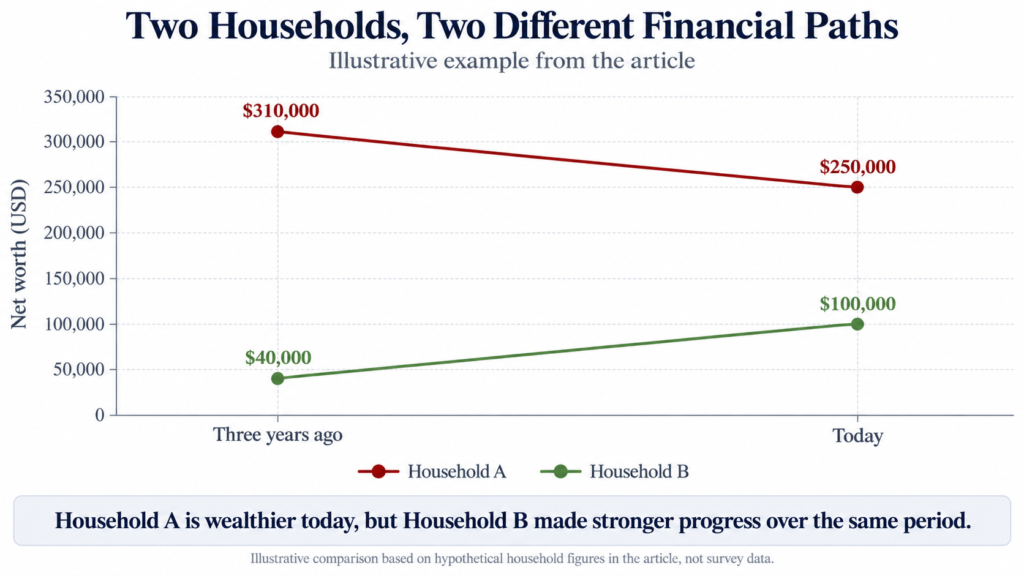
Consider two households.
One has a net worth of $250,000, down from $310,000 three years earlier. Another has $100,000, up from $40,000 over the same period.
The first household is wealthier on paper. The second has made considerably more progress.
Of course, the reasons matter. Market declines can temporarily reduce wealth even when someone is saving diligently. Selling investments to cover retirement expenses isn’t necessarily a sign of poor financial management.
Still, tracking the trend gives people a starting point for asking better questions.
Are debts shrinking? Are retirement investments growing? Is spending leaving enough money to save?
A single number cannot answer everything. Watching it change can reveal where to look.
Financial Anxiety Is Keeping People Away From Their Own Numbers

Western & Southern also found that 56% of respondents described their financial situation as stressful.
Another 44% had delayed checking accounts or bills because they were anxious about what they might discover.
Looking at a credit card balance after an expensive month isn’t especially enjoyable. Neither is opening an investment account after a market decline.
But avoiding the numbers doesn’t change them.
An unpaid balance continues accumulating interest whether someone checks it or not. A retirement savings shortfall doesn’t disappear because the account stays unopened.
There is an important distinction here, though.
Financial anxiety can quietly influence everyday decisions, from putting off bills to avoiding conversations about money. But recognizing these patterns is often the first step toward changing them.
The video below, Is Financial Anxiety Holding You Back?, offers a closer look at a problem many people experience but rarely talk about openly.
Knowing your numbers doesn’t automatically mean you can afford to improve them.
Someone struggling with rent, groceries, childcare, and debt payments probably understands that money is tight. Calculating net worth won’t suddenly create additional income.
Financial awareness is useful because it helps identify priorities. It isn’t a substitute for earning enough money to cover necessary expenses.
The survey’s findings also shouldn’t be treated as exact measurements of every American household. Its opt-in sample was heavily weighted toward millennials, and the researchers acknowledged possible self-selection bias.
The results reveal interesting financial habits, not a definitive national financial-literacy score.
Americans Have Big Wealth Targets, but Many Don’t Know Their Starting Point

There’s an interesting contradiction between this research and another recent survey.
Charles Schwab’s 2025 Modern Wealth Survey found that Americans believe they need an average net worth of $839,000 to feel financially comfortable.
As we discussed in our earlier article on the $839,000 financial comfort target, that figure says plenty about Americans’ expectations, but relatively little about what any particular household actually needs.
Now consider that three-quarters of respondents in Western & Southern’s separate survey couldn’t estimate their current net worth without checking.
Americans have fairly ambitious ideas about how much wealth they need. Yet many aren’t regularly measuring how close they are to those goals.
The contrast becomes more interesting when we examine actual household wealth.
According to the Federal Reserve’s 2022 Survey of Consumer Finances, median American family net worth was $192,900.
The average was much higher, at approximately $1.06 million, because wealthy households pull the arithmetic average upward.
The median is more useful for understanding the typical American family’s position.
Age changes the comparison considerably, too. Median net worth was $39,000 for families younger than 35 and $409,900 for families aged 65 to 74.
Those figures describe 2022 finances, so they aren’t precise benchmarks for 2026. They do show why one national wealth target makes little sense across every age group.
Retirement Readiness Might Be the More Serious Blind Spot
The survey also found that only 32% of respondents could confirm they were on track for retirement.
The remaining respondents reported being behind, not currently saving, or uncertain about their progress.
That concerns me more than the ability to recite net worth from memory.
Retirement planning involves questions that a current account balance cannot answer by itself.
How much income will you need after leaving work? How much are you contributing? How many years remain? What returns are reasonable to assume?
A household with $300,000 in retirement savings might be doing well at age 35 and facing a serious shortfall at age 64, depending on its expected spending and other resources.
Net worth is a useful starting point, but what it isn’t is a retirement forecast.
The number becomes valuable when connected to an actual financial plan.
Checking Net Worth Twice a Year Is a Reasonable Starting Point

Most households don’t need to monitor net worth every morning.
Daily investment movements create noise, and property values don’t need constant updating. A quarterly or twice-yearly review is enough to establish a useful long-term record for many people.
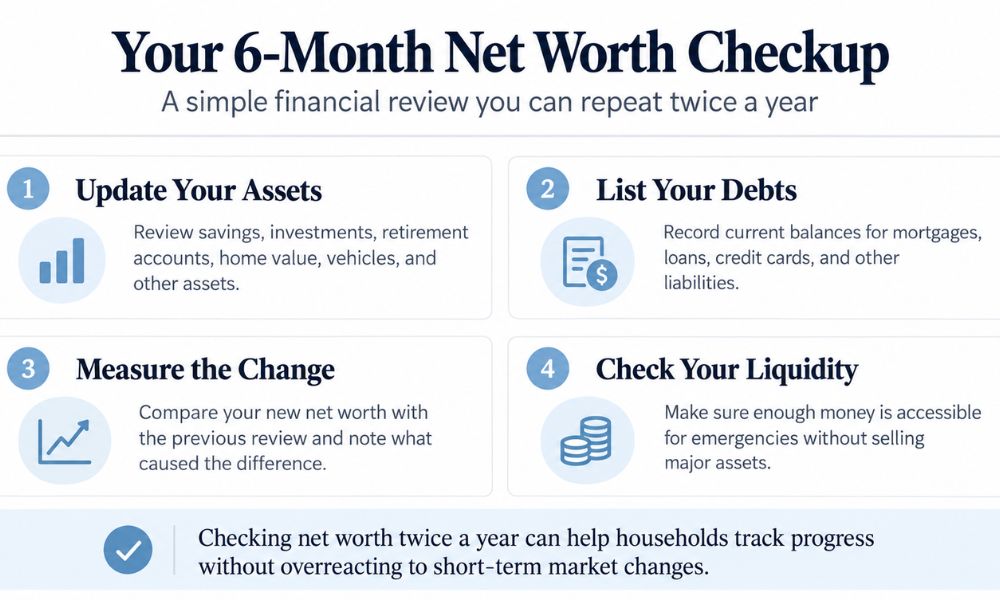
A practical review should cover four areas:
- Assets: Update savings, investments, retirement accounts, and reasonable property values.
- Debts: Record outstanding loan balances and credit card debt.
- Change: Compare the new net worth figure with the previous review and identify what caused the difference.
- Liquidity: Check how much money is accessible without selling a home or withdrawing retirement funds.
That last point deserves special attention.
A household can have substantial net worth and still struggle to pay an unexpected $3,000 bill.
The best financial picture combines wealth, cash flow, borrowing costs, and liquidity.
Technology can make the calculations easier. Indeed, 29% of respondents said they already use AI tools to help manage their finances, although only 11% trusted AI more than a human financial advisor.
The software isn’t the important part. Accurate numbers and sensible decisions are. Always were.
Knowing Your Net Worth Won’t Make You Wealthy, but It Gives You a Baseline
The Western & Southern survey reveals a genuine gap in how Americans monitor their financial health.
Still, you shouldn’t judge someone’s financial competence by whether they can state their net worth without opening an app.
There’s little benefit in memorizing a figure that changes as investments move and debts get repaid.
What matters is knowing roughly where you stand, checking your progress, and recognizing when something needs attention.
A rising net worth doesn’t guarantee financial security, particularly if the wealth is difficult to access. A falling net worth doesn’t automatically mean someone is making bad decisions.
Context matters, and you should pay more attention to whether a household’s debt is becoming manageable, whether retirement savings are progressing, and whether unexpected expenses can be covered without borrowing.
Those are the numbers that determine how money actually works in everyday life.
And they’re worth checking long before someone starts worrying about whether they’re wealthy enough.